

Description
Ascorbyl Glucoside
| Subject | Description |
|---|---|
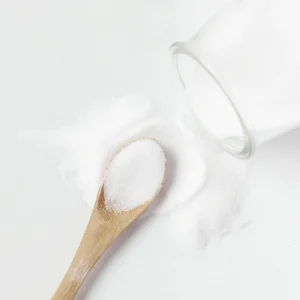
| Appearance | White powder |
| pH | 2.3 ~ 2.4 |
| Active ingredients | L-Ascorbic acid 2-glucoside ≥98.0% |
| Applications | Cosmetic products |
| Suggested Concentration | 2% |
| Function | Anti-aging, Whitening agent |
| INCI Name | Ascorbyl Glucoside |
| Storage conditions | Suitable: Keep/store only in original container. Keep container tightly closed. Store in a cool dry place |
| Shelf-Life | 12 months from manufacturing date |
V2G (Ascorbyl Glucoside) stands out for its innovative process in which a glucose molecule is bonded to vitamin C at the C-2 hydroxyl group through a biotechnology method using a glucose-transferring enzyme that transfers glucose from starch to vitamin C. This results in a form of vitamin C with significantly higher stability than regular vitamin C and other vitamin C derivatives.
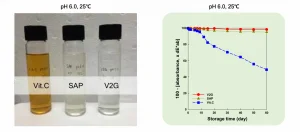
Testing shows that when stored at pH 6.0 and 40°C for 60 days, V2G remains almost 100% intact, while regular vitamin C retains only about 20% and Sodium Ascorbyl Phosphate retains about 60%. It also demonstrates strong resistance to metal-ion oxidation; when exposed to Cu²⁺, V2G retains 90% of its structure after 10 minutes, while regular vitamin C remains at only about 10%.
When applied to the skin, the naturally occurring enzyme α-glucosidase gradually breaks down V2G, releasing pure vitamin C to act continuously. It effectively helps reduce signs of aging, brightens the complexion, and provides strong antioxidant protection. It is recommended for use at levels up to 2% in all types of skincare formulations.
Mechanism of Action of Ascorbyl Glucoside
Active Ingredient: Ascorbyl Glucoside (L-Ascorbic acid 2-glucoside)
Chemical Structure:
Ascorbyl Glucoside is a compound formed by bonding a glucose molecule to vitamin C (L-Ascorbic acid) at the C-2 hydroxyl group— the position where natural vitamin C is most vulnerable to degradation. This glucose attachment protects vitamin C from oxidation, heat, humidity, and metal ions, resulting in far greater stability than regular vitamin C.
Mechanisms of Action
1. Release of Pure Vitamin C on the Skin (Enzymatic Cleavage)
When V2G comes into contact with the skin, α-glucosidase—an enzyme naturally present in human tissues such as the small intestine and skin—hydrolyzes V2G, separating glucose and vitamin C. The released pure vitamin C penetrates the skin and works effectively as an anti-wrinkle and whitening agent. Tests show that V2G is completely hydrolyzed within 4 hours.
2. Anti-wrinkle – Inhibition of Collagen-degrading Enzymes (Inhibition of MMP-1 Expression)
Sunlight (UVA, UVB, NIR) generates reactive oxygen species (ROS), which activate collagen-degrading enzymes (MMPs). These enzymes break down collagen and lead to wrinkles. V2G suppresses MMP-1 production in both UVA-exposed and non-exposed skin, with a stronger effect under UVA exposure. Its inhibitory effect increases with concentration.
3. Anti-wrinkle – Enhancing Collagen Synthesis
Vitamin C released from V2G activates the enzyme Prolylhydroxylase by converting it from its inactive form (Fe³⁺) to its active form (Fe²⁺). This enzyme transforms proline into hydroxyproline, an essential component of strong collagen. Studies show that V2G at 1 mM is more effective at stimulating collagen production than other vitamin C derivatives. At 0.25 mM, V2G maintains consistent collagen-boosting activity for 5 days, while regular vitamin C declines daily.
4. Brightening – Inhibition of Melanin Production (Inhibition of Melanogenesis)
Sun-induced ROS activates tyrosinase, the enzyme responsible for melanin formation. Tyrosinase converts tyrosine into DOPA and subsequently into melanin. V2G inhibits tyrosinase by binding to its copper ion (Cu²⁺), reducing melanin synthesis. Tests show that V2G at 10 mM offers the strongest melanin-inhibiting effect, and over 3 days it maintains consistent performance, unlike regular vitamin C which declines each day.
5. Reduction of Existing Pigmentation (Melanin Reduction – Lightening Effect)
Vitamin C released from V2G can convert dark melanin into its reduced (colorless) form, helping fade dullness, dark spots, and melasma. A clinical study using a lotion containing 2% V2G applied three times daily for 3 weeks showed reduced redness and pigmentation, with approximately 70% user satisfaction.
6. Antioxidant Protection (ROS Scavenging)
V2G effectively neutralizes ROS caused by sunlight and pollution, protecting the skin from damage and premature aging. DPPH radical scavenging tests show that V2G has antioxidant activity comparable to pure vitamin C.
Benefits and Applications
-
Reduces wrinkles and helps prevent new ones
-
Boosts collagen production for firmer, more elastic skin
-
Brightens the complexion and reduces dark spots and melasma
-
Lightens existing pigmentation
-
Protects skin from oxidative damage and UV-induced stress
-
Highly stable—does not discolor or degrade easily
-
Suitable for all skincare products, especially lotions, serums, and creams
-
Recommended usage level: up to 2%

Thermal & pH Stability Test
Method:
Prepare 1% (w/v) solutions of three vitamin C derivatives—V2G (Ascorbyl Glucoside), SAP (Sodium Ascorbyl Phosphate), and Vit. C (regular Vitamin C)—in two types of buffer solutions: phosphate buffer (pH 6.0) and citrate buffer (pH 2.5). Store the samples in the dark for 60 days at temperatures of 25°C and 40°C. Analyze the remaining amount of each compound using HPLC.
Research Study
1. Takada et al., 2024 – “Treatment with Ascorbyl Glucoside–Arginine Complex Ameliorates Solar Lentigos” (International Journal of Molecular Sciences)
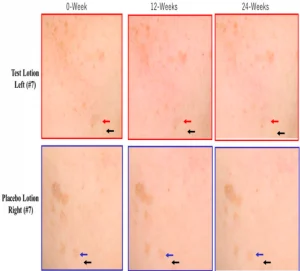
The study reported that applying a lotion containing 28% AGAC (Ascorbyl Glucoside–Arginine Complex) continuously for 24 weeks significantly reduced dark spots and visibly brightened skin tone—without causing irritation.
2.A study conducted by the Department of Dermatology at the University of Tokyo compared the efficacy and stability of various vitamin C derivatives, including Ascorbyl Glucoside. The findings showed that Ascorbyl Glucoside is significantly more stable than regular vitamin C, particularly under high-humidity and high-temperature conditions. The research demonstrated that the glucose attachment at the C-2 hydroxyl group helps protect vitamin C from oxidative degradation.
In addition, the study found that when Ascorbyl Glucoside comes into contact with skin cells, the enzyme α-glucosidase within the cells gradually and continuously hydrolyzes it, releasing pure vitamin C. This sustained release contributes to longer-lasting anti-wrinkle and brightening effects compared to regular vitamin C.
Skin irritation tests showed that Ascorbyl Glucoside is highly safe and does not cause irritation even at high concentrations, making it suitable for use in skincare products for all skin types, including sensitive skin.
Reference
1. Imokawa, G. Melanocyte Activation Mechanisms and Rational Therapeutic Treatments of Solar Lentigos. Int. J. Mol. Sci. 2019, 20,
3666.
2.Yamamoto, I., et al. “Stability and efficacy of ascorbyl glucoside in cosmetic formulations.” Journal of Dermatological Science, 2016, 82(3): 151-159
Product Safety and Warranty Information
- The product is manufactured through a certified process by leading organizations and has certification for industry standards that can be referenced.
- The product is safe and can be used to support the registration of a cosmetic product.
- The product is a raw material for industrial use, not a finished product. Users must have the knowledge and appropriate tools for using the raw material.
- The product is warranted according to the specifications, please refer to the terms and conditions for details.